
FIR vs CSR Explained: What's the Difference?
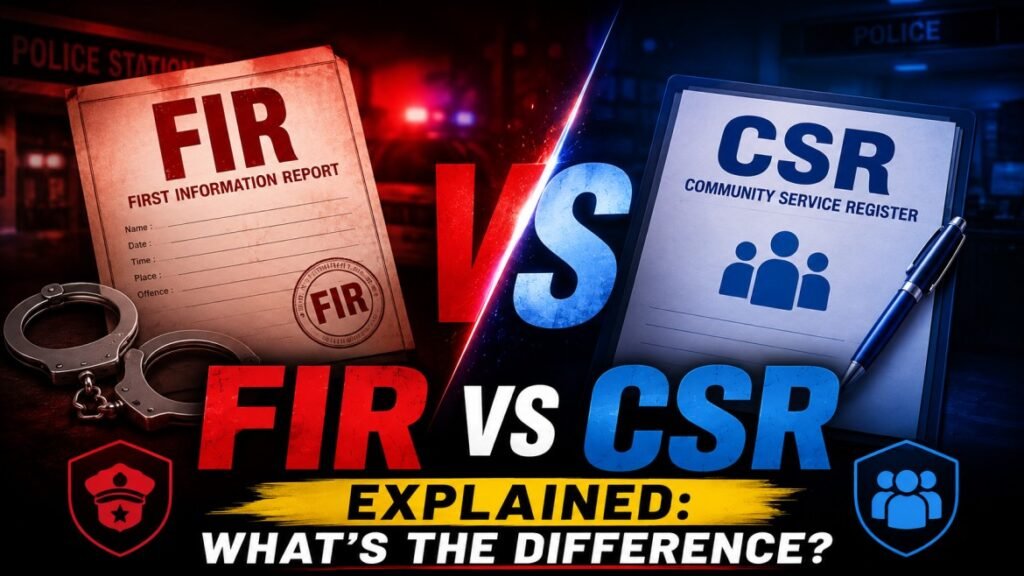
Have you ever visited a police station in Chennai, Coimbatore, Madurai, Trichy, or any other district in Tamil Nadu to file a complaint, only to receive a CSR receipt instead of an FIR?
Many people walk out of the police station confused.
“Is my complaint registered?”
“Why didn’t the police file an FIR?”
“Can a CSR become an FIR?”
“Does a CSR have legal value?”
If you have these questions, you’re not alone
What is an FIR?
FIR stands for First Information Report. It is the first official document prepared by the police when they receive information about a cognizable offence.
Once an FIR is registered, the police have the legal authority and duty to investigate the matter.
Examples include:
- Murder
- Kidnapping
- Dowry harassment
- Rape
- Theft
- Robbery
- House breaking
- Serious assault
- Cyber fraud involving criminal offences
- Large financial cheating
What is a CSR?
CSR means Community Service Register.
When a complaint does not immediately require registration of an FIR, police may enter it into the Community Service Register and issue a CSR Receipt.
This receipt acts as an acknowledgment that the complaint has been received.
However, a CSR is NOT an FIR.
It does not automatically start a criminal investigation.
FIR vs CSR – Quick Comparison

Why Do Police Issue a CSR Instead of an FIR?
Many people believe that the police intentionally avoid registering FIRs.
That is not always true.
Police issue a CSR when:
- Facts need preliminary verification.
- The complaint appears civil in nature.
- The dispute relates to family matters.
- It is a neighbourhood dispute.
- The complaint concerns a minor issue.
- No cognizable offence is disclosed at first glance.
However, if the complaint clearly reveals a cognizable offence, the police cannot refuse to register an FIR merely by issuing a CSR.
What is a Cognizable Offence?
A cognizable offence is a serious crime where the police can:
- Register an FIR
- Start investigation immediately
- Arrest without prior permission from the Magistrate (subject to applicable law)
What is a Non-Cognizable Offence?
These are relatively less serious offences.
Police usually:
- Receive the complaint.
- Issue a CSR.
- Conduct preliminary enquiry if necessary.
- Advise parties to approach the Magistrate when required.
When Should Police Register an FIR?
The police are expected to register an FIR when information clearly discloses a cognizable offence. Eg – Theft, Dowry Harassment, Online Fraud, Physical Assault, Child Kidnapping etc.,
When is a CSR Usually Issued?
A CSR may be issued for situations like Neighbour disputes, Boundary issues, Family misunderstandings.
Is a CSR Legally Valid?
Yes but only for few limited purposes.
A CSR refer as:
- Proof that you approached the police.
- An acknowledgment of your complaint.
- A reference number for follow-up.
However, it does not:
- Automatically initiate a criminal case.
- Give the police investigation powers equivalent to an FIR.
- Result in filing a charge sheet by itself.
Can a CSR Become an FIR?
Yes.
This is one of the most misunderstood aspects of criminal law.
If, during preliminary enquiry, the police discover that the complaint actually discloses a cognizable offence, they should register an FIR.
“CSR-ஆக பதிவு செய்யப்பட்ட புகார், பின்னர் கடுமையான குற்றம் இருப்பது தெரிய வந்தால் FIR ஆக மாற்றப்படலாம்.”
What If the Police Refuse to Register an FIR?
If your complaint clearly shows a cognizable offence but the police issue only a CSR or refuse to act you have legal remedies.
You may:
- Submit a written complaint to the higher police authorities.
- Preserve copies of your complaint and CSR receipt.
- Seek appropriate legal advice from the legal experts.
- Approach the jurisdictional Magistrate if the circumstances warrant such action under applicable law.
Need to know: Most important, Avoid arguing with the officers at the police station. Maintain written records and follow the legal process.
Common Misconceptions About FIR and CSR
Myth 1: CSR and FIR are the same.
NO. A CSR acknowledges receipt of a complaint, while an FIR formally starts a criminal investigation.
Myth 2: Police can always refuse to register an FIR.
NO. If the complaint clearly discloses a cognizable offence, the law generally requires registration of an FIR.
Myth 3: A CSR has no value.
NO. A CSR plays most important useful as proof that a complaint was lodged and needed for future legal proceedings or purposes.


